
Bionetic
Loading
Bionetic
Loading
Bionetic
Loading
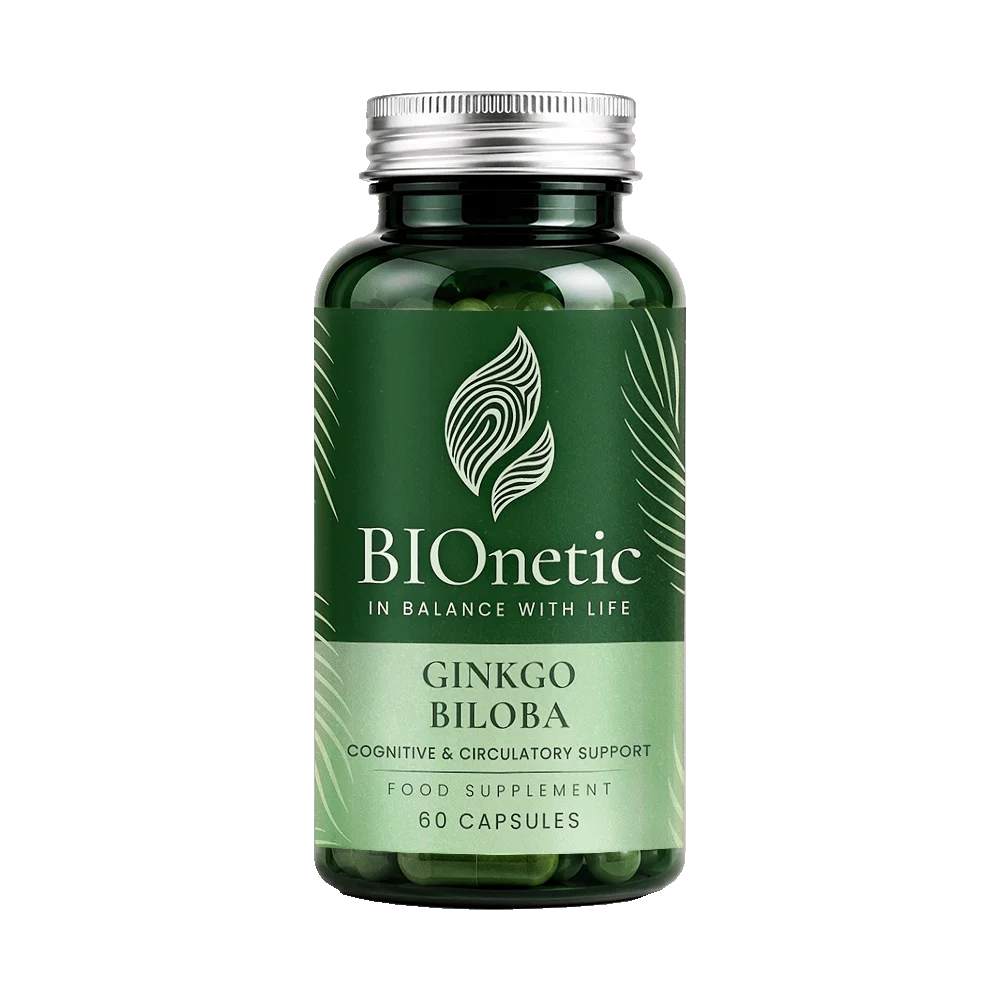
Few botanicals have accumulated as much clinical research as Ginkgo biloba. With over 400 published trials, the picture that emerges is of a plant extract with genuinely distinct mechanisms for enhancing cerebral circulation, protecting neuronal membranes, and supporting working memory.
Ginkgo biloba is the oldest living tree species on Earth — a living fossil unchanged for 270 million years — and also one of the most extensively studied botanical medicines in human history. The standardised leaf extract known as EGb 761® has been the subject of over 400 published clinical trials, making it one of the most evidence-rich natural compounds in existence. What emerges from this body of research is not a vague brain tonic story but a precise mechanistic picture of how specific ginkgo compounds act on cerebrovascular perfusion, neuronal oxidative stress, and synaptic signalling.
The two principal active fractions of Ginkgo biloba extract are flavone glycosides (primarily quercetin, kaempferol, and isorhamnetin glucorhamnosides) and terpene lactones (ginkgolides A, B, and C, and bilobalide). Bionetic's standardised extract provides 24% flavone glycosides and 6% terpene lactones — exactly the ratio used in the landmark clinical trials. This ratio is not arbitrary: it reflects the balance found to produce the observed improvements in cerebrovascular perfusion while minimising variability between batches.
The ginkgolides work primarily by selectively inhibiting platelet-activating factor (PAF) — a phospholipid mediator that promotes platelet aggregation, increases blood viscosity, and triggers inflammatory responses in the cerebrovascular endothelium. By blocking PAF, ginkgo improves microcirculation in the brain's smallest vessels, enhancing delivery of oxygen and glucose to neurons that are particularly sensitive to hypoperfusion. This mechanism is especially relevant in the context of age-related decline, where cerebral blood flow naturally decreases and small vessel disease becomes a growing contributor to cognitive slowing.
The flavone glycosides contribute a complementary layer of protection: they are potent scavengers of reactive oxygen species (ROS) — the free radicals generated by mitochondrial metabolism and inflammatory processes that gradually degrade neuronal cell membranes and DNA. Long-term oxidative stress is a key driver of synaptic loss and the structural changes seen in cognitive ageing. By quenching ROS specifically in neural tissue, ginkgo's flavonoids help preserve the physical integrity of synaptic structures that support learning and memory consolidation.
Clinical outcomes across the trial base are consistent: improvements in working memory, information processing speed, and sustained attention in healthy adults, alongside measurable reductions in symptoms of age-related cognitive decline and cerebrovascular insufficiency. A 2012 meta-analysis in Human Psychopharmacology pooling data from nine randomised controlled trials found statistically significant improvements in composite memory scores and executive function indices with EGb 761®. For people seeking cognitive support grounded in the deepest evidence base available in botanical science, Ginkgo biloba remains the gold standard.
More from the blog
